

Tucked away in the forested hills of northern Romania, just beyond the modest bustle of Gura Humorului, stands Voroneț Monastery, an icon of Romanian heritage and Orthodox faith. I’d seen it in books and online for years—the vibrant blue frescoes, the meticulous Last Judgment wall—but nothing compares to seeing it with your own eyes, especially through the viewfinder of a camera.
As a photographer, I approach sites like this with a mix of reverence and curiosity. I’m not just here to capture postcard shots—I want to see what the camera can reveal about a place that’s already been photographed a thousand times. And Voroneț, with its legendary Voroneț Blue and centuries of whispered history, offered plenty of inspiration.
I arrived early in the morning. The road from Suceava wound through sleepy villages, mist clinging to the fields like breath on glass.

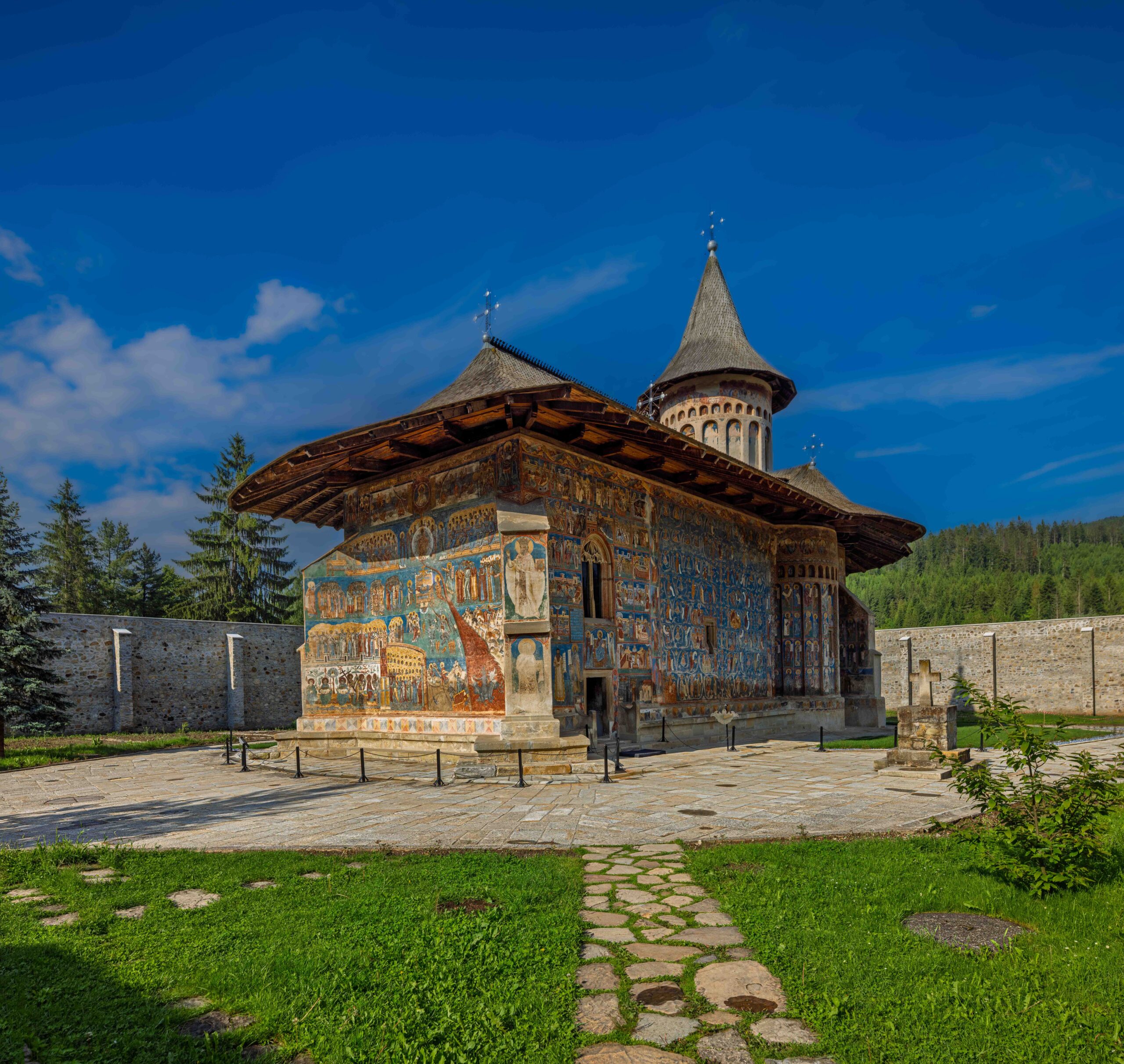
I parked just outside the monastery gates and was greeted by birdsong and silence. No tourist buses yet, no chatter. Just the wind moving through the trees and the solid, grounded presence of the monastery walls.
From the moment I passed through the gate, I knew I was somewhere special. The deep celestial blue of the exterior frescoes isn’t just striking—it’s magnetic. They say the formula for Voroneț Blue has been lost to time, and I believe it. It seems to glow even under flat light, pulling your eye across saints, angels, demons, and empires, frozen mid-motion on the stone.
My first shots were simple frames: wide angles to take in the whole scene, textures of the stone, details of the artwork. But I knew I wanted more than snapshots.
I had brought a few tools to experiment with:
-
A tilt-shift lens for architectural precision and creative control,
-
A Lensbaby for a dreamlike, soft-focus aesthetic,
-
And of course, my drone for an overhead perspective few people get to see.
With the tilt-shift lens, I created a composite image of the entire façade, correcting for distortion while preserving perspective. It took several overlapping shots stitched together in post, but the result captures the grandeur of the western wall in one clean, crisp frame. It’s technical, sure—but deeply satisfying.
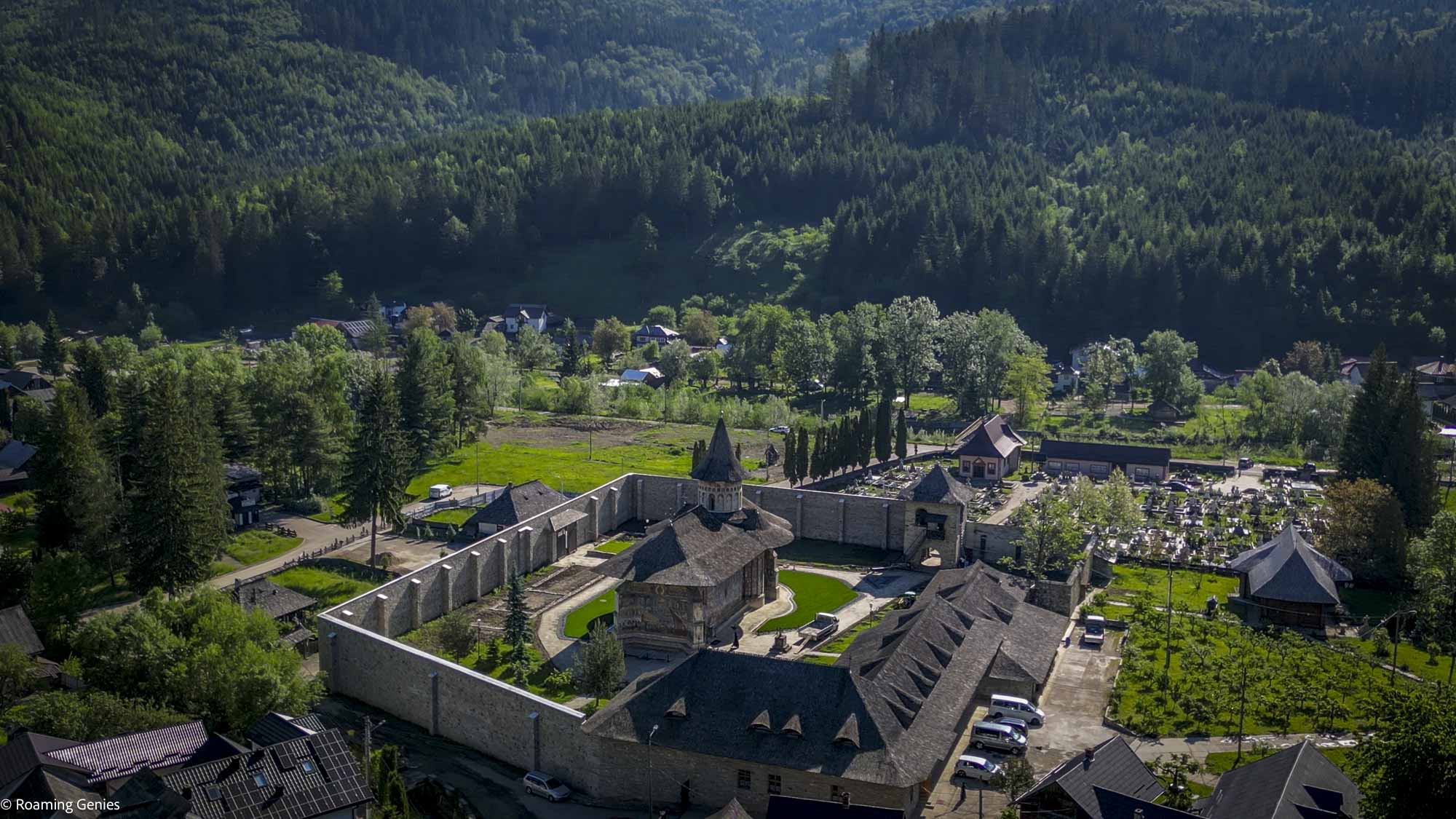
From above, the drone revealed a symmetry and scale that you simply can’t appreciate from ground level. The layout of the monastery, the surrounding trees, the contrast between the tidy rooflines and the chaos of the painted walls—it’s like seeing a sacred diagram drawn in stone and shadow.
But my favorite shots came from the Lensbaby. That glass bends reality in beautiful ways. I used it to focus on a single figure in the Last Judgment, letting the edges blur into a painterly haze. It felt like stepping into the fresco itself—timeless, reverent, alive.
Photography isn’t allowed inside the church, and I didn’t fight that. Inside, the space is thick with candle smoke and centuries of devotion. Gold leaf glints in the dim light. Every wall is painted. It’s a place meant to be experienced, not captured. I put my camera away and sat quietly in the back pew, letting the silence and scent of old incense settle around me.
There’s a feeling inside that no lens can convey. As a photographer, that’s humbling—and freeing. You don’t always have to document everything. Sometimes it’s enough to see and feel, and let the moment remain yours alone.
Useful Information
♦ Parkup:
Your content goes here. Edit or remove this text inline or in the
♦ Water:
module Content settings. You can also style every aspect of this content
♦Dining:
in the module Design settings and even apply custom CSS to this text in the module Advanced settings.


Outside, I spent time with the details: a crack in the paint shaped like a lightning bolt, moss growing in the seams of the stone, the weathered edges of a saint’s halo. The monastery isn’t just painted; it’s weathered, worn, alive with history. I shot textures in macro, hunting for the invisible layers most visitors never stop to see.
It’s not the sharpest photo that tells the best story—it’s the one with weight behind it.
Later, I moved slowly around the grounds, trying to frame the monastery against the slowly lifting mist. With the tilt-shift I created a clean elevation from the side, almost like an architectural drawing. With the drone, I hovered just high enough to keep the surrounding forest in frame, placing the monastery like a jewel in a setting of trees.
But again, it was the Lensbaby that surprised me most. I photographed a nun walking across the gravel path, her black habit cutting a soft silhouette across the haze. Everything around her blurred gently. It wasn’t a perfect photo, technically. But it had mood. It had reverence.
Though Voroneț is the most famous of the painted monasteries, it’s just one of many gems in Bukovina. If you’re a photographer, this region is an endless series of visual gifts: foggy mornings over hayfields, horses pulling carts past wooden gates, mountains wrapped in layers of light.
I stayed in a local guesthouse nearby, where the owners made me plum jam and fresh eggs in the morning. In the evening, I reviewed the day’s images with a glass of țuică by the fire. Slowing down is part of the process here. Life moves gently. And that gentleness seeps into your work.
Your Title Goes Here
Your content goes here. Edit or remove this text inline or in the module Content settings. You can also style every aspect of this content in the module Design settings and even apply custom CSS to this text in the module Advanced settings.
LPG
Your content goes here. Edit or remove this text inline or in the module Content settings. You can also style every aspect of this content in the module Design settings and even apply custom CSS to this text in the module Advanced settings.
Water Sources
Your content goes here. Edit or remove this text inline or in the module Content settings. You can also style every aspect of this content in the module Design settings and even apply custom CSS to this text in the module Advanced settings.
Parkup
Your content goes here. Edit or remove this text inline or in the module Content settings. You can also style every aspect of this content in the module Design settings and even apply custom CSS to this text in the module Advanced settings.
Visiting Voroneț Monastery as a photographer is more than a box to tick or a subject to shoot. It’s an opportunity to slow down, to look closer, to respect beauty that endures not because it demands attention, but because it invites it.
Photography here isn’t about showing off gear or chasing perfect light. It’s about translating feeling into form, and letting the spirit of the place come through in subtle ways—a curve of color, a crack in the plaster, a shadow across a painted wing.
If you ever get the chance to stand before that incredible blue wall in the quiet of a spring morning, bring your camera—but more importantly, bring your patience. The story you’ll capture isn’t just visual. It’s something deeper. And that’s the kind of photo that stays with you.
Your content goes here. Edit or remove this text inline or in the module Content settings. You can also style every aspect of this content in the module Design settings and even apply custom CSS to this text in the module Advanced settings.
Your content goes here. Edit or remove this text inline or in the module Content settings. You can also style every aspect of this content in the module Design settings and even apply custom CSS to this text in the module Advanced settings.
Your content goes here. Edit or remove this text inline or in the module Content settings. You can also style every aspect of this content in the module Design settings and even apply custom CSS to this text in the module Advanced settings.


Recent Comments